// Alba D'Urbano
//

Main;
Projects() {
Esposizione Impraticabile() {
}
Mare();
The Negated Room();
Hautnah();
Touch Me;
Stoffwechsel;
Il Sarto Immortale();
Die Wunderschöne Wunde;
Tra cielo e terra;
L'età dell'oro();
Venere;
Private Property();
Monitoraggio;
corpo_insegnante();
Natura Morta(); Redden/Erröten; Son_no;
Airbag;
Collaborations();
Net-Works();
History();
Imprint;
Esposizione impraticabile() {
In Vitro;
} //1996
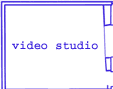
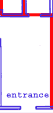
The installation "In Vitro" was developed in 1996 for the Institut für Neue Medien (Institute for New Media-INM) in Frankfurt am Main. For this version of "Esposizione Impraticabile", a concept was worked out that involved the means of reproduction used at the INM. The technology, the rooms, and the presentation tools used to create worlds of electronic images were included in the installation.
 The
journey through the installation began in a basement
room of the institute that was not accessible to the visitors. The pictures
were set up in this room, but they could only be seen fromoutside through
a small glass window in a locked
door. A video
camera on a swivelling tripod was installed in the middle of the room,
and it transmitted its optical input to another room one
storey higher. On the ground floor, visitors could go through different rooms
and see the works only as technical reproductions, like tracks left by the
artworks: as interactively controllable video pictures transmitted live and
projected onto a wall; as a documentary on the monitors of an editor's
workplace; in the copy
place as an art historical look back at the past of the current installation;
as a web
camera offering worldwide
access to the inaccesible exhibition in the basement room; and as digitally
produced slides in the institute's lighted
display case. At the end of the hall,
the visitors could find an interactive computer simulation of the exhibition
in the basement. The visitors could use a space mouse to interactively
move around in a virtual room created by the computer. If he approached the virtual
pictures, they dissolved first into fuzzy spots and then into the ASCII-coded
representation of the picture. These ASCII
code pictures were also to be found on the walk through the building.
They were printed on paper and put up on the walls of the workrooms,
taking the place of the prints normaly on display. Practically every room
in the institute and all of its technical equipment was involved in the artwork,
and the visitor could move through the different rooms like
the stations of a show-jumping course. The absent artwork moved through
the institute's technical equipment as a reality that has been obsesssively
reproduced and alienated by the media, thus transforming the workshops themselves
into a synthesis of the arts.
The
journey through the installation began in a basement
room of the institute that was not accessible to the visitors. The pictures
were set up in this room, but they could only be seen fromoutside through
a small glass window in a locked
door. A video
camera on a swivelling tripod was installed in the middle of the room,
and it transmitted its optical input to another room one
storey higher. On the ground floor, visitors could go through different rooms
and see the works only as technical reproductions, like tracks left by the
artworks: as interactively controllable video pictures transmitted live and
projected onto a wall; as a documentary on the monitors of an editor's
workplace; in the copy
place as an art historical look back at the past of the current installation;
as a web
camera offering worldwide
access to the inaccesible exhibition in the basement room; and as digitally
produced slides in the institute's lighted
display case. At the end of the hall,
the visitors could find an interactive computer simulation of the exhibition
in the basement. The visitors could use a space mouse to interactively
move around in a virtual room created by the computer. If he approached the virtual
pictures, they dissolved first into fuzzy spots and then into the ASCII-coded
representation of the picture. These ASCII
code pictures were also to be found on the walk through the building.
They were printed on paper and put up on the walls of the workrooms,
taking the place of the prints normaly on display. Practically every room
in the institute and all of its technical equipment was involved in the artwork,
and the visitor could move through the different rooms like
the stations of a show-jumping course. The absent artwork moved through
the institute's technical equipment as a reality that has been obsesssively
reproduced and alienated by the media, thus transforming the workshops themselves
into a synthesis of the arts.
(Frankfurt 1996)
 |
|
|
|
|
|
|
|
|
|
|
|
|
 |
 |
 |
 |
 |
|
|||||||
 |
 |
|
||||||||||
 |
 |
 |
 |
|
||||||||
 |
 |
|
||||||||||
 |
 |
|
||||||||||
 |
 |
 |
 |
 |
 |
|
||||||
(Frankfurt 1991)